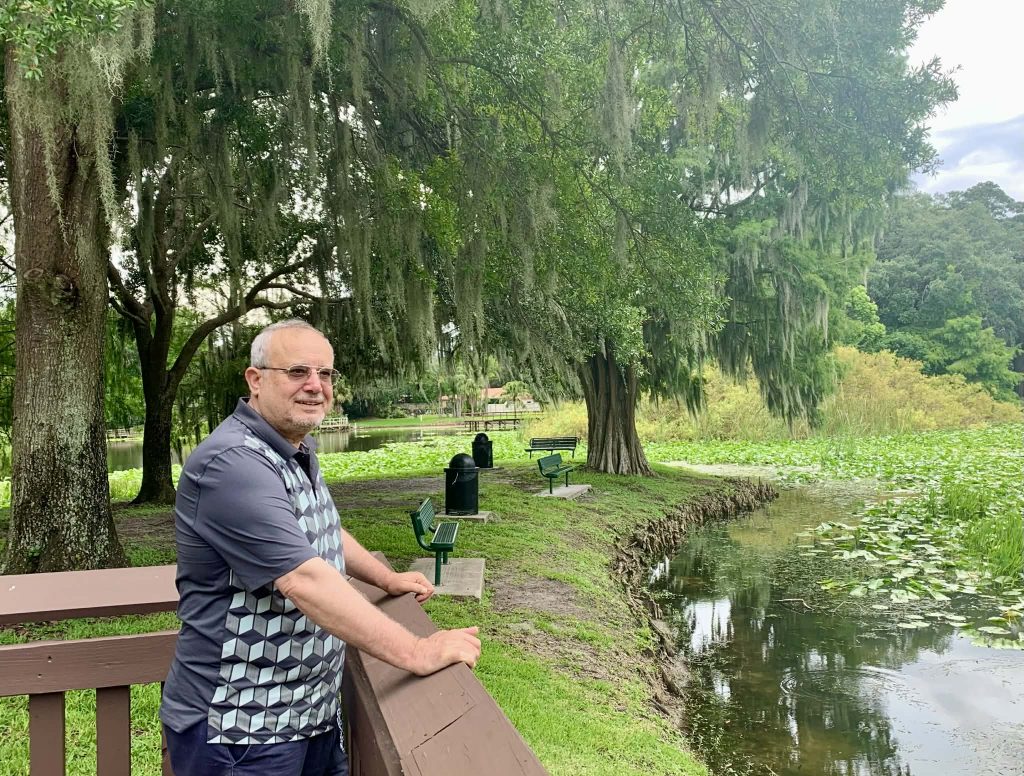
Dr. Khaled Nigim, along with his family, has made Sarnia-Lambton home since 2008. Khaled’s professional background is as an academic and electrical engineer, specializing in renewable energy.
Before arriving in Canada almost 25 years ago, Khaled managed the planning and implementation of many infrastructural projects for the Palestinian Economic Council for Development and Reconstruction (PECDAR). PECDAR’s mission has been to coordinate millions of dollars in donor aid to use those funds to manage thousands of projects in education and health care, like building universities and hospitals across Palestinian territories.
Khaled was involved with economic policy planning and project implementation throughout Palestinian municipalities and in connection to various government ministries.
While in his position, Khaled managed funds from the World Bank and other countries, leading to the establishment of clinics, schools, roads, water lines, and sewers.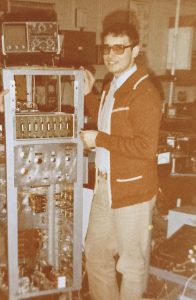
Even after moving to Canada, Khaled continued his work as an international consultant for the Ministry of Education in Palestine. From 2014 to 2017, he assisted eighteen different educational institutions in Gaza and West Bank with quality curriculum development.
With all of this experience in mind, I approached Khaled with a request to speak to how he has coped with what has happened to Palestinians and in particular, Gaza, his homeland.
Khaled, how many loved ones have you lost in Gaza, and how many have lost their homes?
The deaths have all been from my sister’s family: my sister’s daughter, who is my niece, along with two of my niece’s sons, her husband and his family. Also, my sister’s other daughter lost her young daughter. Many have experienced injuries. Most of my high school and university friends along with their families have lost everything. A few escaped to Egypt and with that, no one guarantees they will ever return.
Khaled, how has all this loss impacted you?
I have deep sadness for the loss of life of many of my family members, friends, colleagues, and neighbours. I’m also sad for those who have survived but who have lost everything. Additionally, is the loss of Gaza’s rich historical heritage, which is agonizing in its own right.
You were not just born and raised in Gaza, as an engineer, you helped establish many important buildings and resources for the Palestinian people. To have them destroyed must be heartbreaking for you.
When the warring started, and we started hearing about some of the hospitals being destroyed, it flashed me back to the time where I was the developer of that hospital’s beginnings. That’s connected me to Gaza, not only because all my family lived in Gaza, but also because of all the achievement I have carried out during my life in Gaza over the 20 years being an engineer there in that place.
I have mixed emotions of sadness and anger, but I always see there is another opportunity for Gaza to reconstruct itself, knowing from the history that Gaza has been invaded so many times and destroyed so many times. That gives me the hope that whatever is happening now is going to be in the past, and the future is going to be very great for Gaza, as it always was a great city.
This 3,000-year-old city was always a very important city for civilization. I like to remind everybody when you go to the hospital and you get a bandage on your arm called gauze — this was established in Gaza.
If you look at the history of the Romans, the majority of their culture and civilizations was based on the trade of goods and businesses through Gaza from Asia, Middle East, to Europe.
So to me, it is very sad personally what’s going on in Gaza, but I’m also optimistic. Gaza will not be destroyed and will not disappear. It will always be Gaza.
I found this poem, written by a Gaza person. His name is Moeen Bessiso. I knew his family.
الشمس تغيب كل يوم لتولد من جديد
The English translation is “Gaza is bleeding but not dying. The sun sets everyday to be reborn in a new day.”
Thank you, Khaled.