
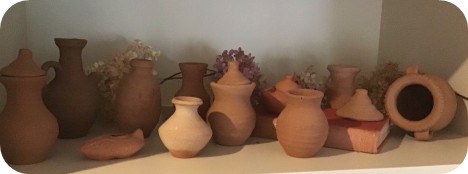
These simple, rustic pieces of pottery have made the remarkable journey from Gaza to the UK and now to Sarnia, Canada! I am a Palestinian from Gaza and my wife is English, and we lived in Gaza from 1984 to 2000, after which we immigrated to Canada. My mother and father-in-law came regularly to visit us and our children in Gaza, and enjoyed visiting cultural sites and craft workshops. I took them often to a pottery shop in an area of Gaza called Al-Fawakhir. There, over a period of years, they bought many small pieces of pottery, oil lamps, water or wine vessels, jars and pots. These small ceramics (varying in size from one to seven inches) are miniature examples of larger pieces, and were made primarily as souvenirs for the burgeoning tourist trade at that time.
Pottery was and still is a major part of the Gaza local economy and is a significant expression of Palestinian national heritage and skill, passed down through generations. The craft faces challenges due to a lack of modern equipment, the destruction of workshops, and the difficulty of importing materials and tools. Despite the challenges, potters continue to pass down the craft using traditional techniques used for 1000’s of years to meet essential needs.
Although our pots are small, souvenir pieces, the pottery workshops’ main production was useful, high demand items for the locals, such as mortars, water vessels to keep water cool, large pots to cook rice and meat inside bread ovens and garden pottery. The clay to make the pots is dug out of the ground on site of the pottery. The potters use basic tools and wheels, similar to ancient times. Archaeologists have found kilns with large amounts of “Gaza Jar” waste in the Gaza Strip, providing clear evidence that they were produced locally on an industrial scale dating back to approximately 1500 BCE. These jars were used to store and transport vinum Gazetum, a sweet wine from the Gaza region that was highly prized and in great demand across the entire Roman world. The presence of Gaza Jars (or gazition in Greek) in archaeological sites across the Roman Empire attests to the extensive commercial relationship and the integration of the Gaza region’s economy into the broader Roman trade
networks.

As a child growing up, my house was about two kilometre or less from the Mediterranean beach. I used to walk to the beach and usually encountered a fragment of pottery along the way. I grew up collecting all those fragments and tried to put them altogether. Every time we would go with our friends to the beach for a picnic, we would put our rice and meat in a pot, bake it and take it with us to the beach, so when we were hungry, we could just scoop it out of that jar. Even the word jar in Arabic is jarra. So obviously, I think that the original word “jar” could possibly be an Arabic word.
Eventually we realized that our area in Gaza had been populated by many other nations, whether it be the Romans or the Greek, and pottery was the main household item and the main infrastructure for moving water from one area to another.
This summer, my mother-in-law asked my wife to take some of the pots that she had been keeping carefully in her UK home to Sarnia, where we now have them proudly on display. The pots represent centuries of Gaza pottery history and have significant historical value. Hopefully, in the future, we can show our collection at the Lawrence House so others may appreciate the collection as well.